In love, what lies on the other side our claim to the truth of our own lived experiences?
The surety that there is an equally veritable claim different from ours that is not ours. More than one. Innumerable. The others we had those experiences with have their own versions and truths. Those who saw or heard or judged those experiences from the sidelines have another. Then there are those who have opinions but no personal connection to any connected parties, and will blithely share them with anyone within earshot. There are those who are invested and those who claim not to care, each sharing a facet of this refracting prism of simultaneous truths. More confusingly, there are different claims from our own that were once ours but are no longer. We are not the same individuals were were a week ago, a year ago, half a lifetime ago. So who decides which truth is true? That privilege resides with whomever is doing the narrating at any given time.
The most liberating thing anyone can do for themselves is to tear up all of their pages and rewrite their own history. Or, failing that, rewrite their understanding of their own history. If real wisdom is knowing that you know very little, then would admitting we can only ever know half of what we think we know be growing wiser? What about creating conditions that make visible the fact that we are never seeing the whole picture, that we can’t trust what’s on the other half of the frame, or that there is even another half to be had? If you are a photographer, the little rectangle that you look through contains the whole knowable world. Move a little to the left and what you know changes. Move a little to the right and it changes again. Turn around 180 degrees and nothing looks as it was. There are no stable truths, no grand unifying theories to be seen from a camera’s viewfinder. Like love, what we think we know of the world is continually shifting and confounding and not what we thought it to be.
I started writing a series about The Art of the Loss of Love when I first began writing about photography over twenty years ago. The first essay was about the photographer Masahisa Fukase and the photographs he made in the wake of his first wife leaving him, which culminated in what I consider to be the greatest photobook ever made, The Solitude of Ravens. The second writing concerned Seiichi Furyua and the photo archives he had made of his wife Christine Gössler, that he has spent a lifetime working and re-working through, which I had come to through an infamous contact sheet that recorded the banality of an ordinary day that ended in his wife’s suicide, all documented in neat 35mm frames. A third essay on another Japanese photographer had always been the plan, but life got in the way and I never got around to writing it. It’s just as well, since everything I thought I wanted to understand about him through writing has changed in the intervening decades. And everything I thought I understood about love has too.
Nobuyoshi Araki is an artist that, on the one hand, is always doing the same thing over and over again ad nauseum: women in kimonos trussed up with ropes and hanging in the air like cast-off courtesans or pieces of meat on display in the window; Tokyo street scenes but more banal than picturesque: garbage trucks, the backs of street signs, tilted skylines. But it is also true that he continually reinvents his own takes, reinvents himself, and the one constant that can be said of him and his work is that, like Heraclitus' river, it is always in flux. If you were to ask someone familiar with his oeuvre what his photographs were like, the images of tightly bound half-naked women would certainly be at the top of the list, then the street scenes of Tokyo, followed by his cibachrome flowers that drip with so much sexuality they would make Robert Mapplethorpe’s erect lilies blush. Words that are used synonymous with Araki and his work: “obsessive” “irrepressible” “voyeuristic” “provocateur” “salacious” “compulsive””sincere”
While his palette and these photos are alluringly lurid, they are not the most interesting photographs he has made. The most honest and intriguing images are the ones that he is making now, at the end of his life. If Nobuyoshi Araki has lived for 86 years as someone with a rapacious appetite for…well, everything, he is now at the moment of having his after dinner drink and waiting for the final check to arrive.
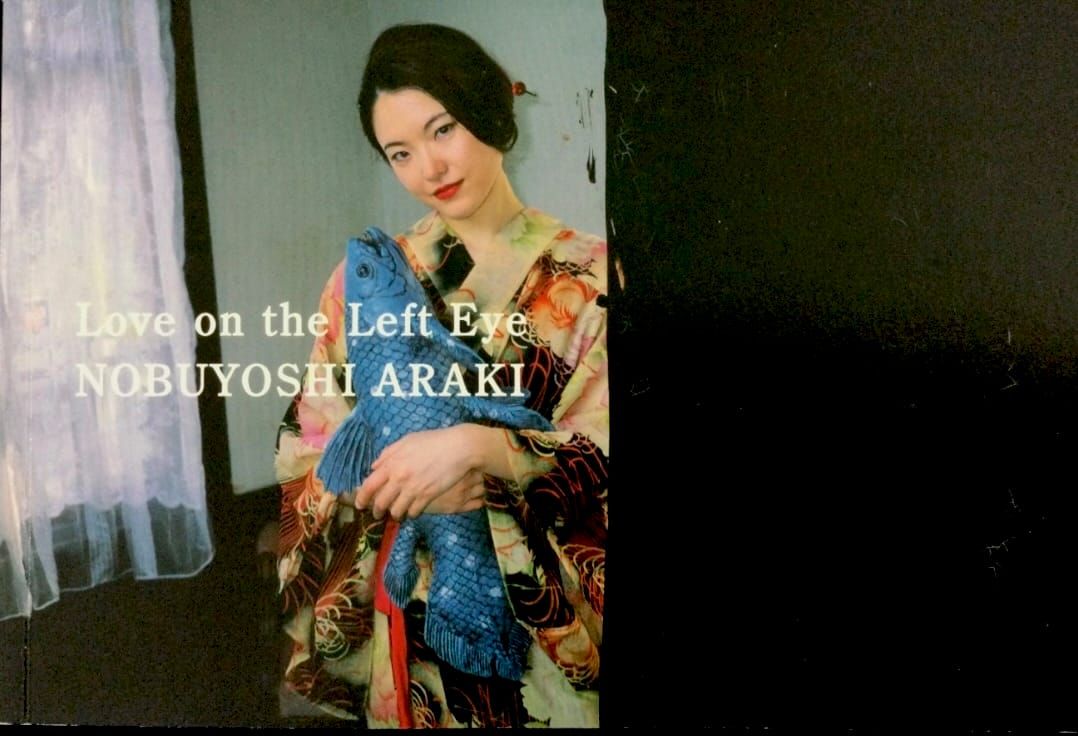
Love on the Left Eye is a photobook I didn’t ever expect to hold in my hands, a scant 300 copies published by Taka Iishi gallery in 2014. But things come to you when they are meant to come, not when you will or want them. Mine arrived at the start of this summer, sitting in the sanctuary of my first apartment coincident with the start of my second divorce. I had searched for this title innumerable times in the past decade, never finding it. A month into my new lease, a copy appeared, winking at me across the Atlantic. Still in the thralls of being able to make purchases without consulting anyone that might veto them, I clicked that magic button that makes things come in the mail to you (for a price). Anticipating that I would also want to be familiar with the title to which Araki nods in his own, I also found a copy of Ed van der Elsken’s Love on the Left Bank, published by André Deutsch in 1956.
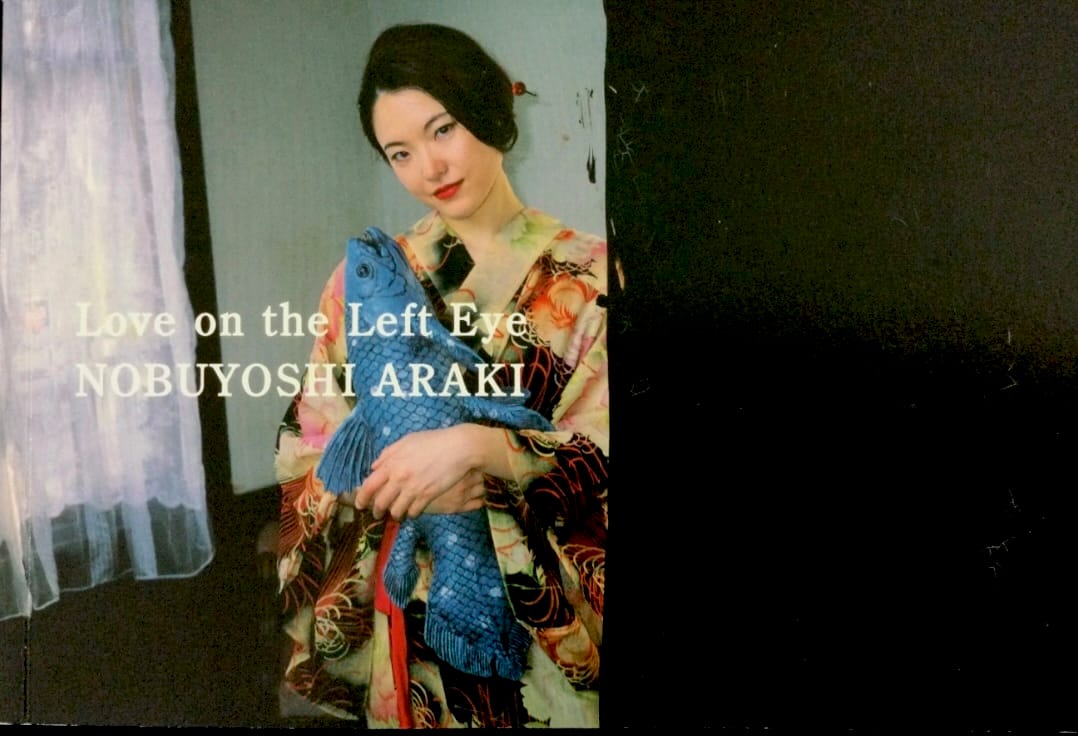
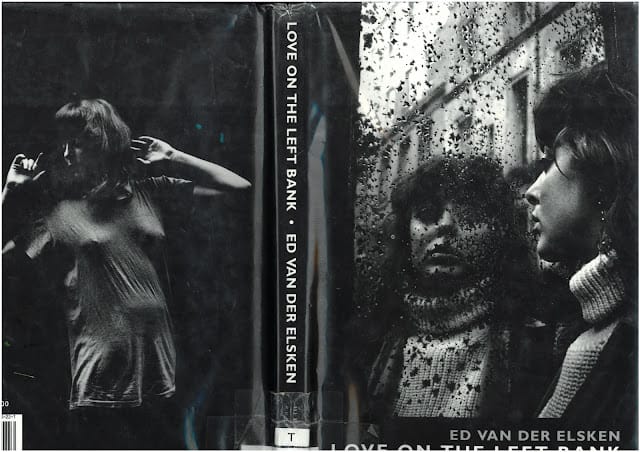
(l-r: Nobuyoshi Araki's Love on the Left Eye, published by Taka Iishi Gallery 2014; Ed van der Elsken's Love on the Left Bank, published by André Deutsch in 1956.
Reviews of this body of work Araki made after he lost his vision in his right eye reflexively—and lazily—declare it an homage to van der Elsken’s, even going so far as to assert that Araki sought out similar compositions and created careful sequences mirroring the Dutchman’s photo-roman of post WWII Paris. I don’t find that to be credible, but that does not mean there are not correspondences. The similarities I have found are more about the sensibilities of the two men as opposed to two books in conversation with one another.
"Anyway, I do as I like without flinching." —Nobuyoshi Araki
Ed van der Elsken made Love on the Left Bank when he was in his 20s, and recently relocated to Paris. His eyes on the city were fresh. His sensibility notably a generation ahead of his Magnum predecessors, for whom he worked at the time as a printer, producing images for Henri Cartier-Bresson, Robert Capa and Ernst Haas. His eye was hungry and while he might have been figuring out what he wanted to do with the camera, he knew what he didn't want to do. And knowing what you are not is half the way to knowing what you are.
As Vince Aletti noted in his profile on him in Artforum:
"...subjectivity was paramount; his best photos embody not just his point of view but his emotional investment and physical involvement, his fierceness, excitement, and joy."
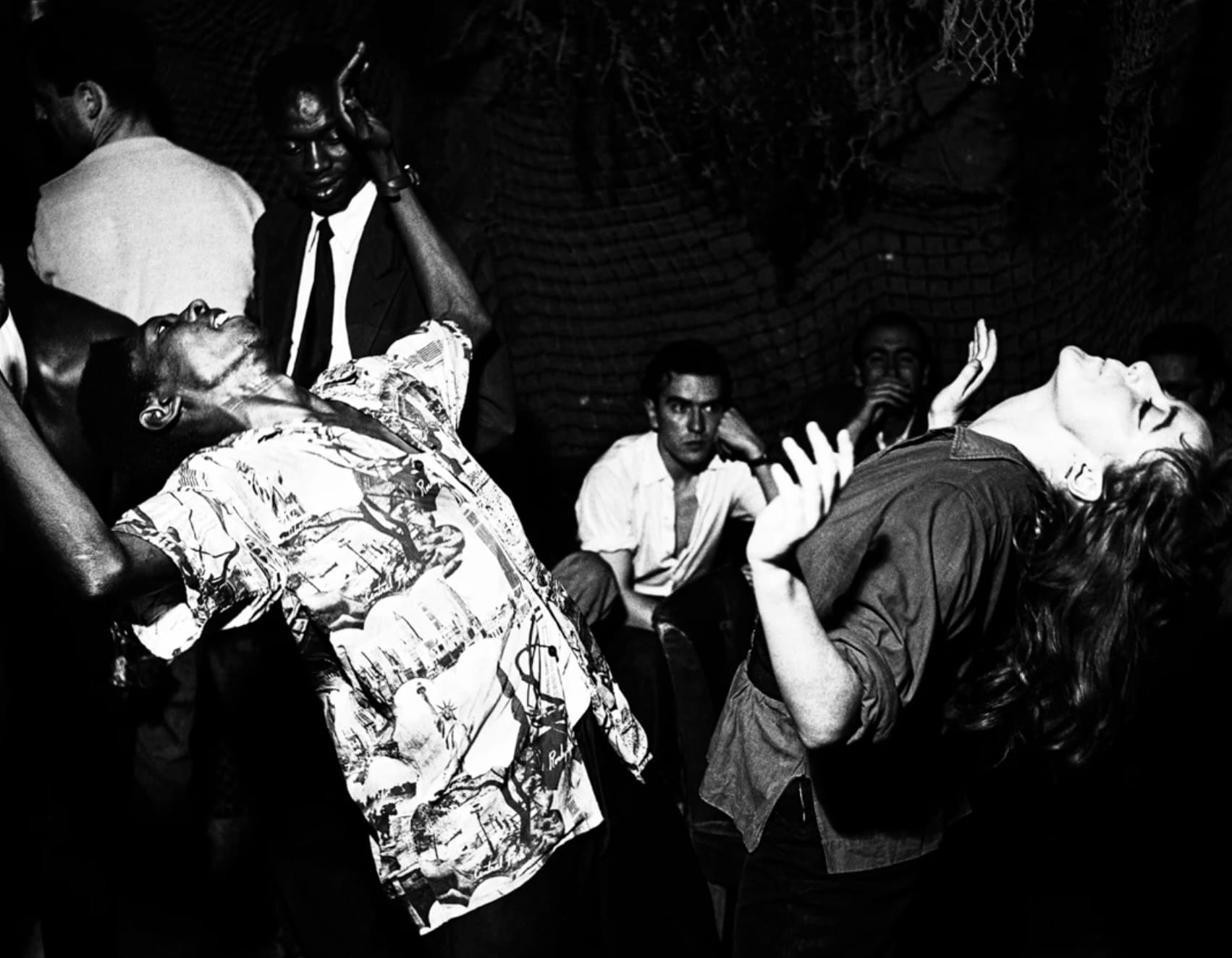
"I'm not a journalist, an objective reporter, I'm a man with likes and dislikes.” —Ed van der Elsken
Following more in the footsteps of Brassaï than Bresson, Elsken night-stalked dingy cafés, dive bars and public squares where the disenchanted and disenfranchised youth of a Post WWII Paris languished, raged and partied with one another, with a rootlessness and free-floating hostility that sang a familiar siren song to Elsken’s camera. The crowd that the photographer fell in (love) with vibrated with a fresh rankness that suited his sensibilities and the cultural moment. Feeling more kinship with Weegee over the founders of Magnum, the images Elsken made for what became Love on the Left Bank evoke all of the senses in the way that a Weegee photo at the scene of a spectacle do: under cover of night there is an illegibility, a city grittiness to the air quality, the loud cacophony of existing in urban public spaces, smells co-mingling with one another that are stifling as well as sexually intoxicating in one inhale.
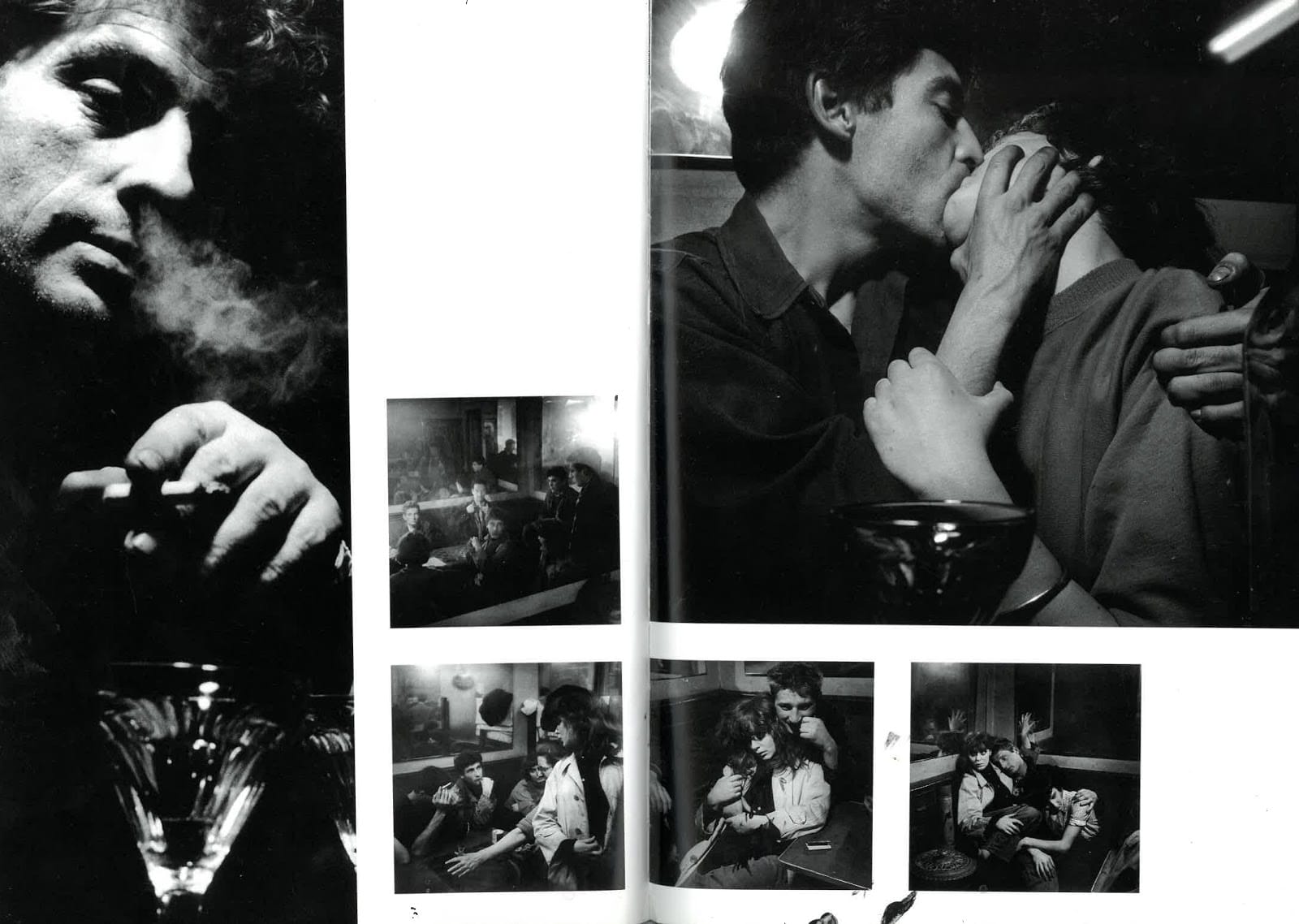
Elsken's resulting sequence is a true photo román, a visual novella. Young people living by their wits, on the edge, getting whatever they can for free whenever they can. During the day they sleep in metros, in movie theaters, slouched over benches in the parks. At night, they circle one another in bars where wine is cheaper than a sausage, in cafes, in shared apartments or hotel rooms or dance halls. There is a very real sense at being at a party with the close familiars of your 20s, and you're in your cups, smoke fills the air and clings to clothes and hair, every woman wears too much make up but it somehow looks sexy and glamorous, the music playing gets better and better and the sexual tension in the room is thickly promiscuous. Elsken gives us close-up photos of faces as if those who are about to kiss we are going to kiss as well. The photos exude the low light of late-at-night-early-in-the-morning, with all of the grain and blurry and mess that being young and having sex with lots of different people before your executive function is fully formed contains. There is jostling, there is gripping, there is passion, there is fleeting and there is leaving.
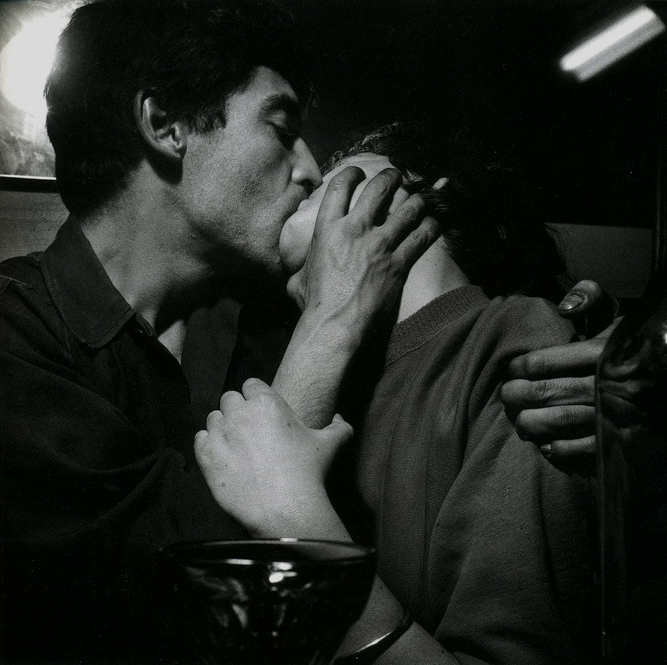
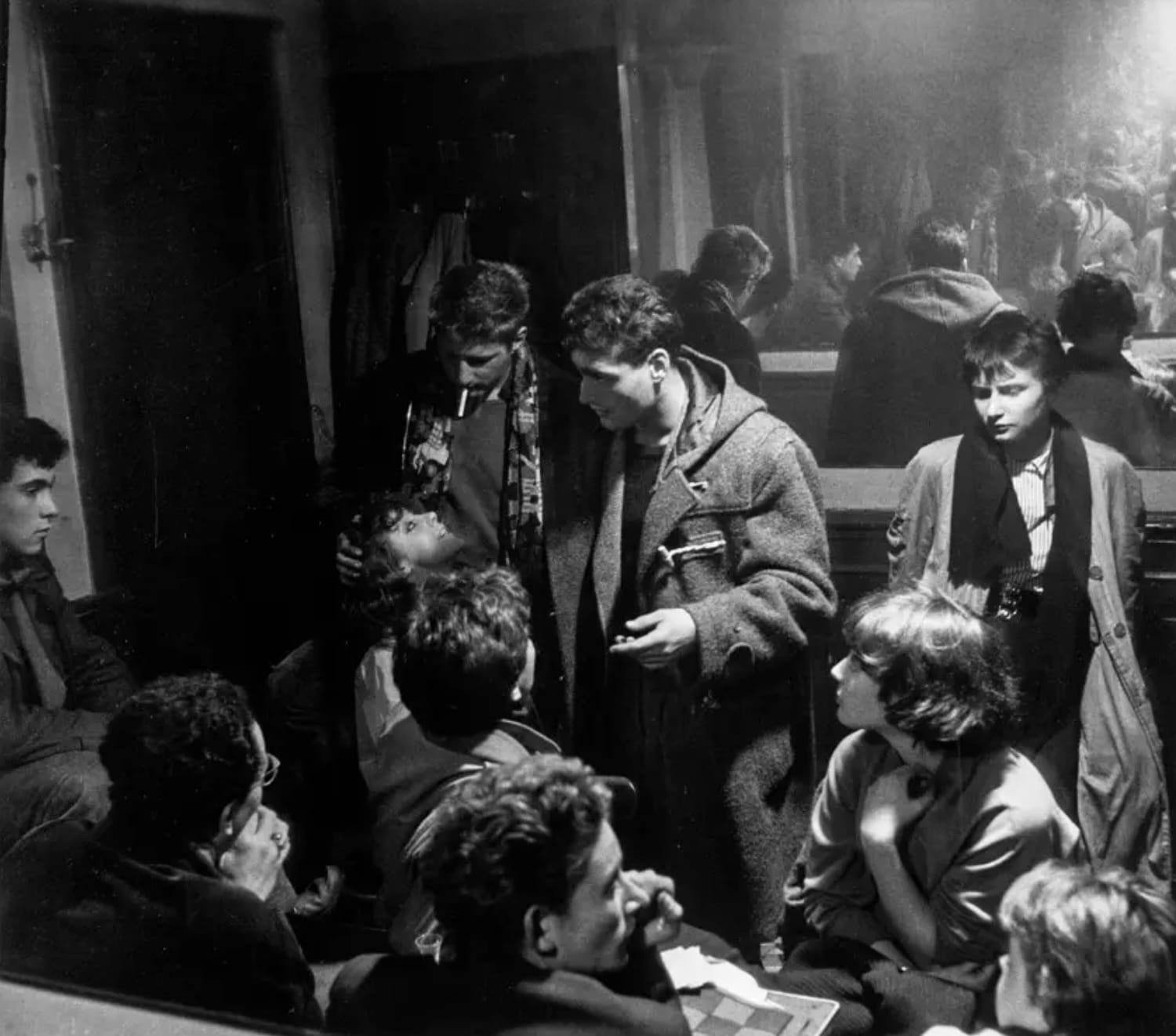
images from Love on the Left Bank, by Ed van der Elsken, 1956.
And in Elsken's novella, there is a story. There are words. There is a trajectory, a longing, a wish fulfilled only to be dashed in the end. Like life. Like love.
Araki first encountered Elsken’s book at twenty, and the fictionalized visual account that Elsken teased from his very real photographs gave tacit permission to the impressionable Japanese photographer to create the first of what he would refer to as his “I-novel”s; a first-person narration that is both speculative and confessional. His first and most famous of which, Sentimental Journey, was a photo diary of his honeymoon that spared the viewer neither boredom or the bedroom of marital life.
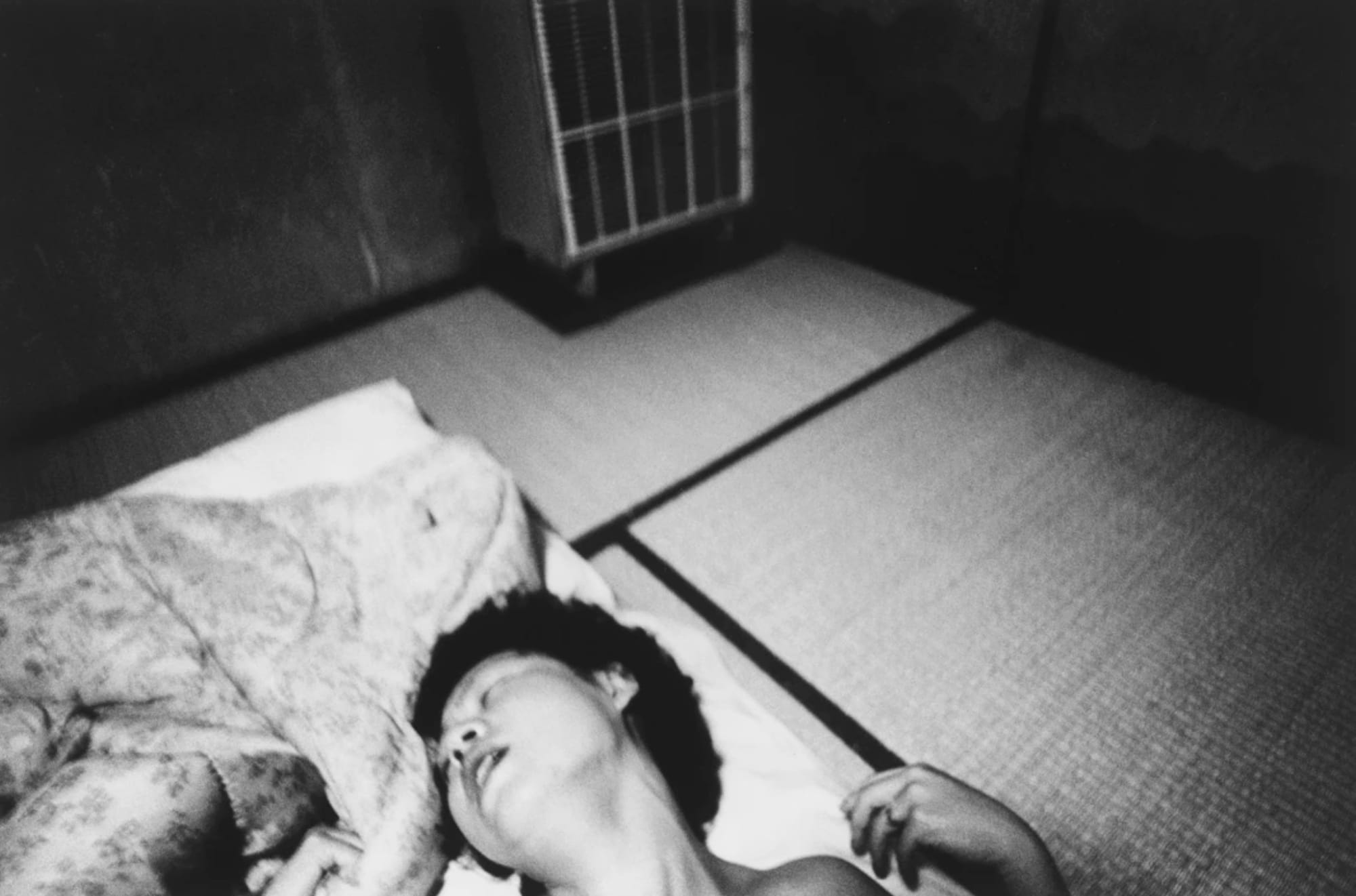
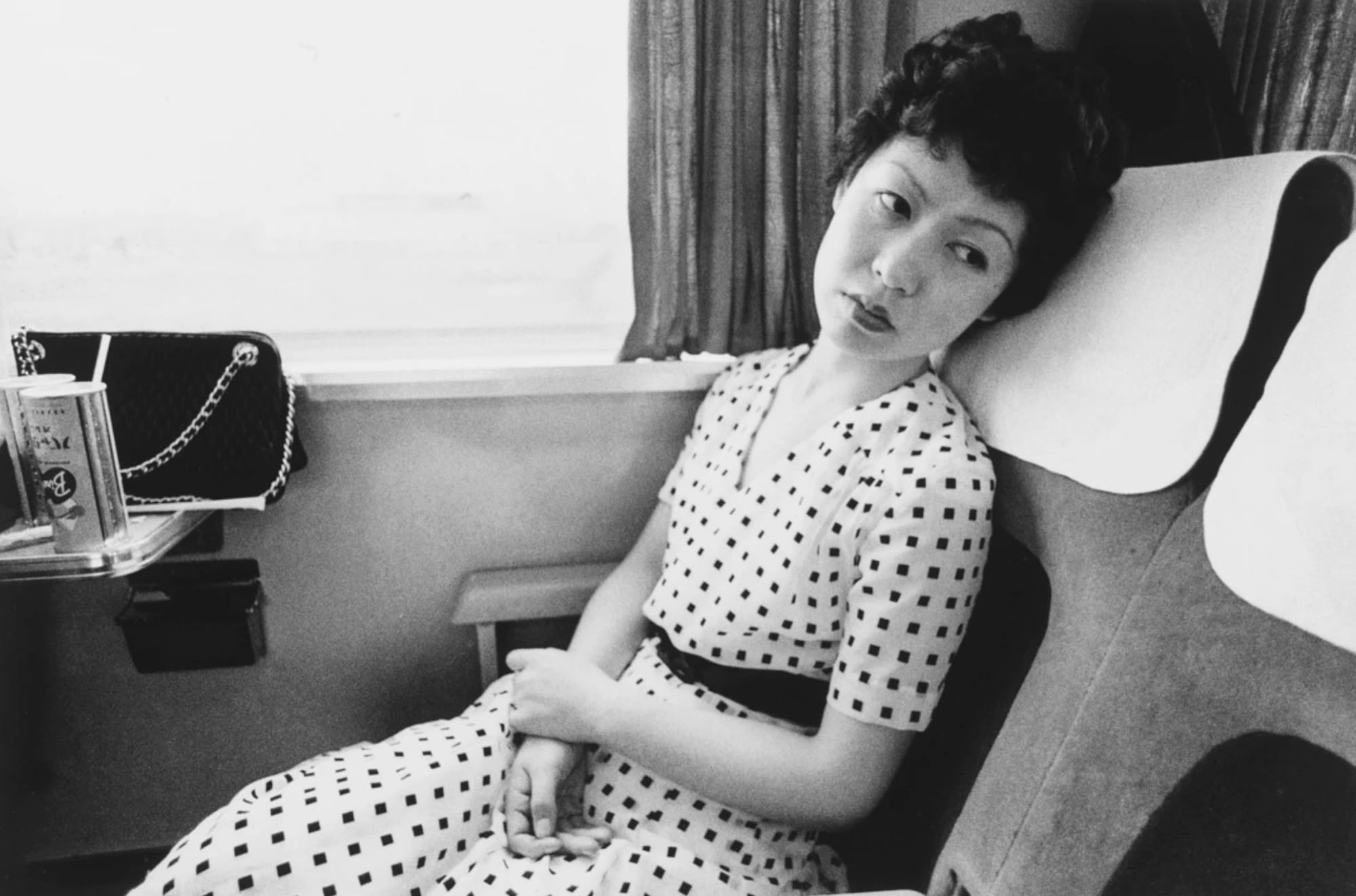
Nobuyoshi Araki, Sentimental Journey, 1971.
In the intervening fifty or so years, Araki has produced over 500 photobooks, the weight of which I was able to hold (figuratively) at his 2018 show at The Museum of Sex. At the time, Love on the Left Eye was one of the more recent publications.
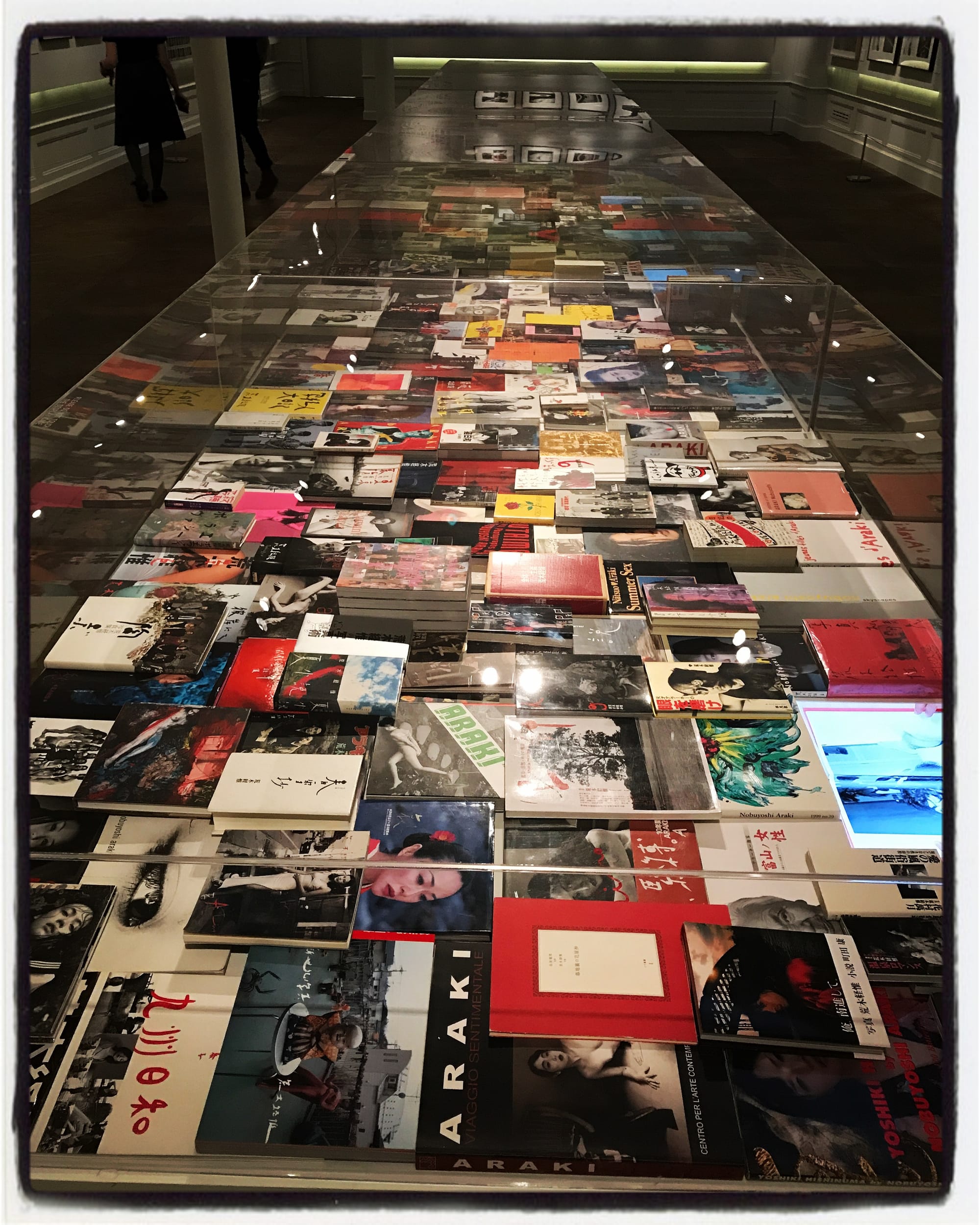
The book consists of 102 images Araki produced in the fall of 2013 once he lost vision in his right eye due to a retinal artery obstruction, a new diagnosis on the heels of a prostate cancer battle he endured in 2009. The book images themselves are thematically recognizable as Araki: naked women (of course), floral arrangements captured in varying states of fullness or decay, collections of Araki’s toys and dolls in the midst of constructed play, skylines, urban streetscapes, and still more nakedness. What differentiates this work from the dizzying sameness of so much of his obsessive output is the bold, unapologetic and messy marking out of the right half of all of the frames, done by soaking the positive transparency film in marker ink prior to having the images printed. The obfuscated black half repeats on every page, two for each spread, each insinuating what you will not be able to see with more rigid finality than what you viewed before.
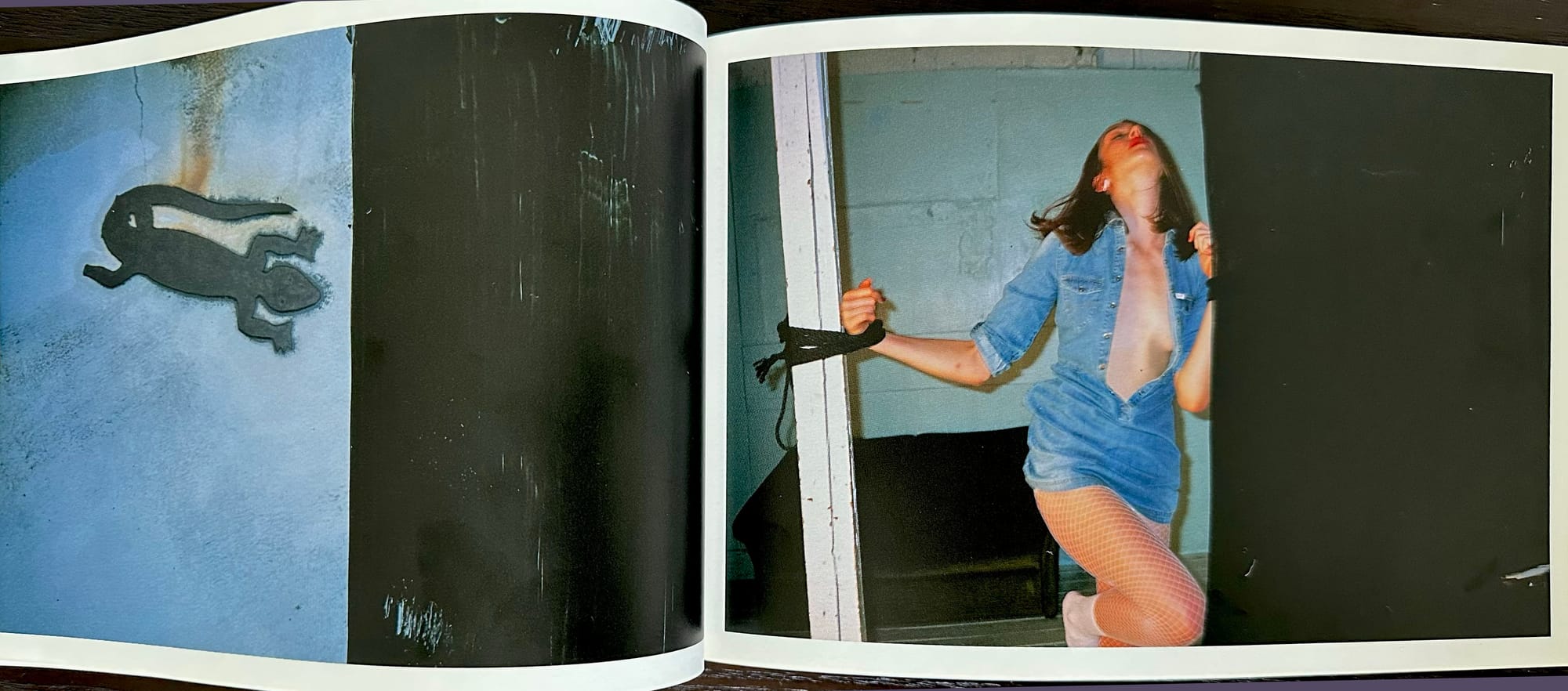
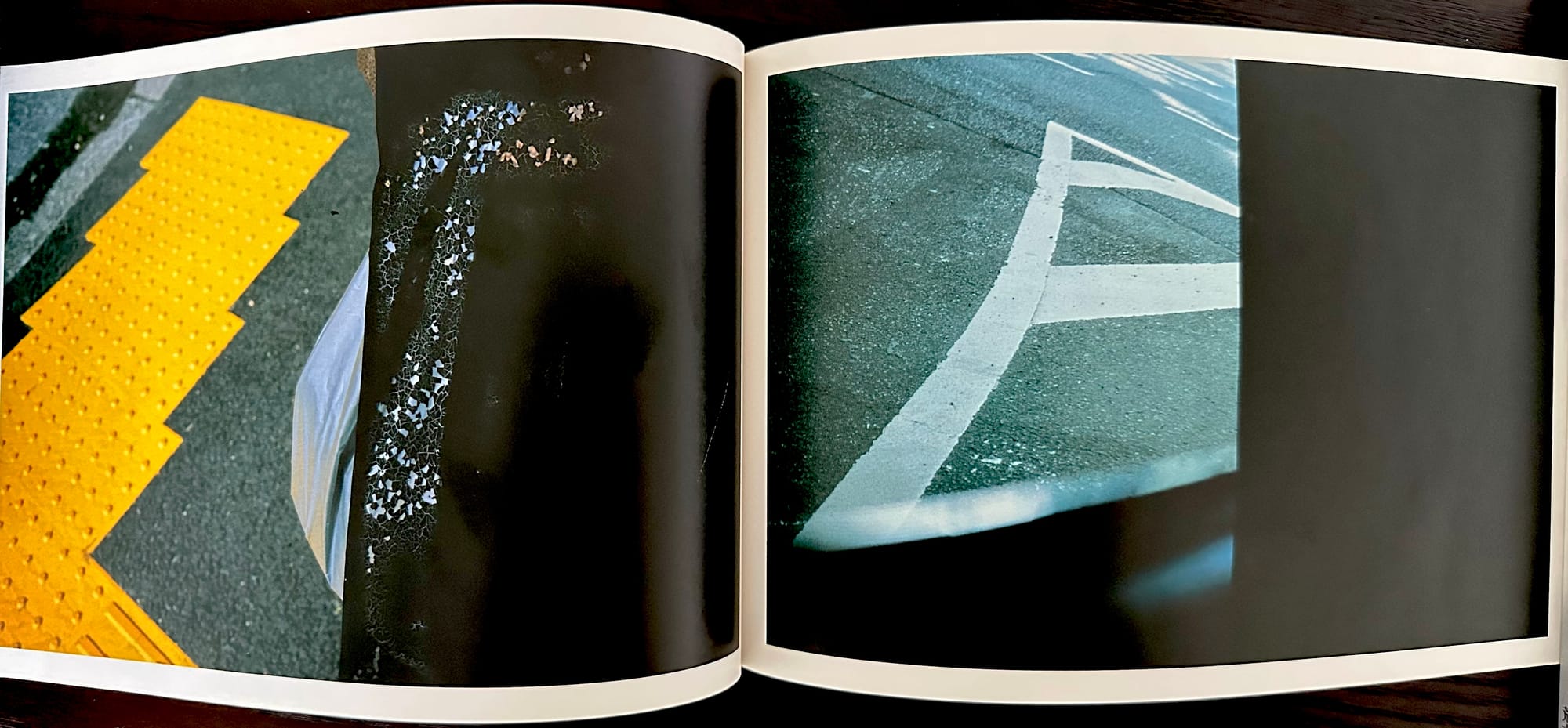
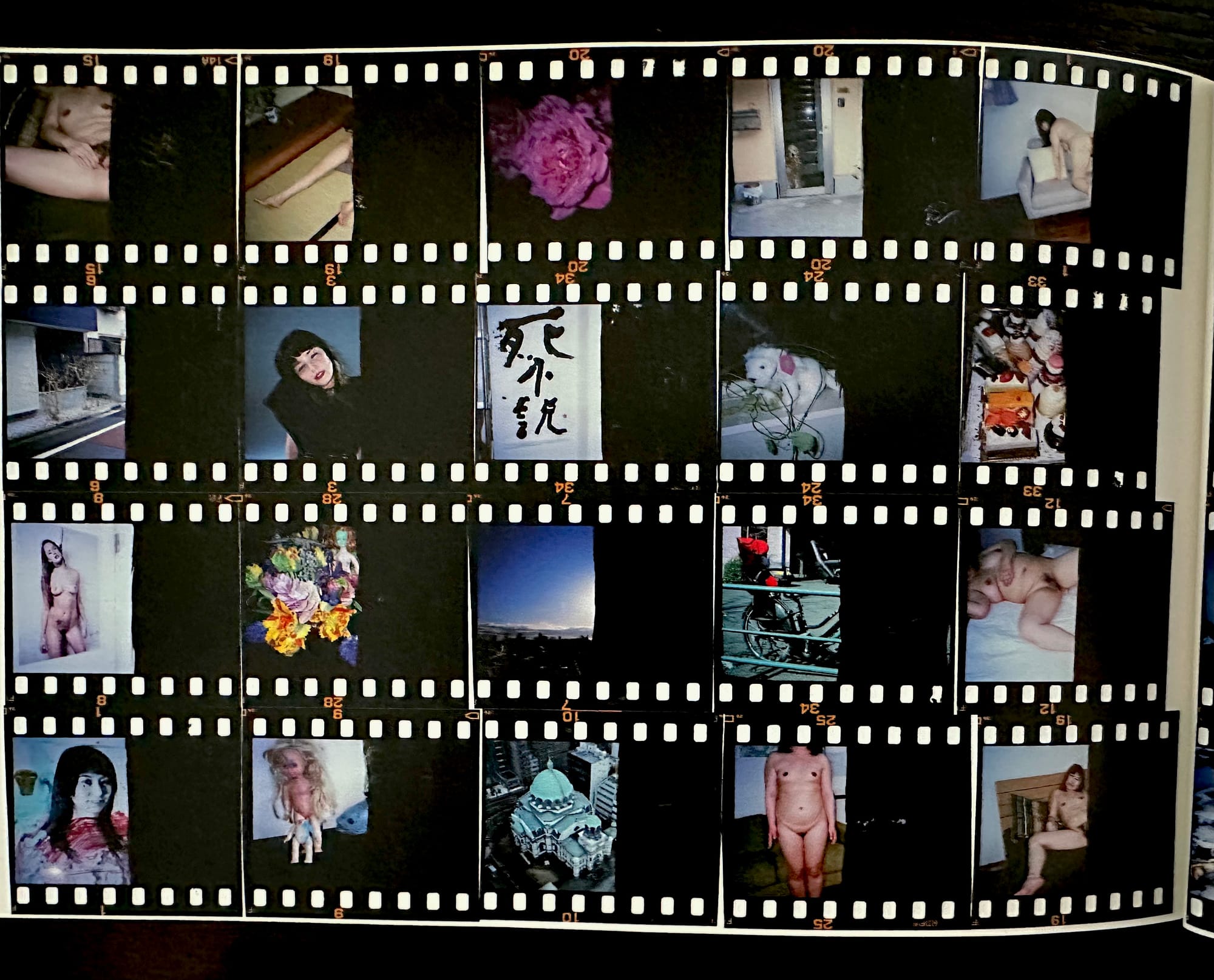
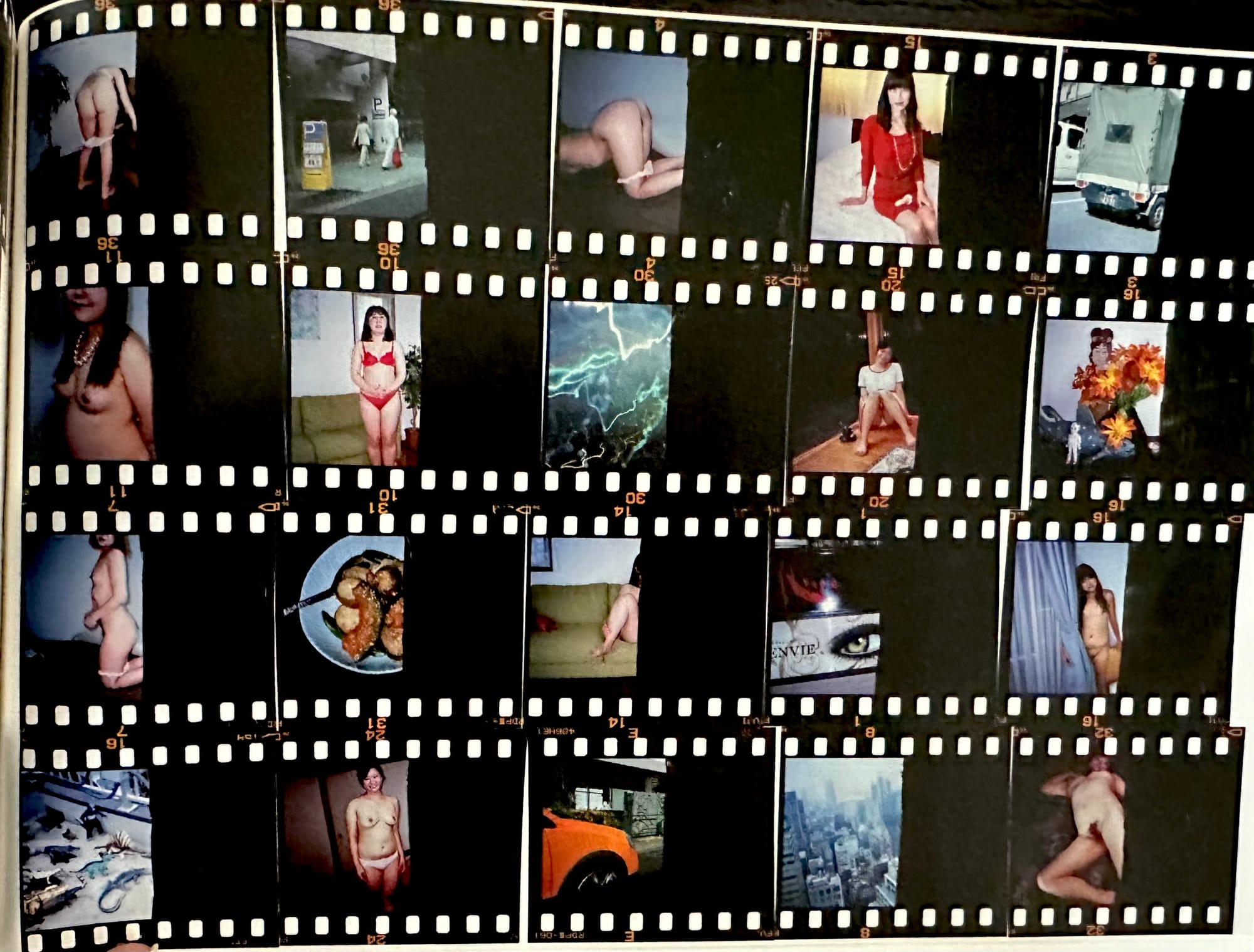
contact sheets for Love on the Left Eye, by Nobuyoshi Araki, published by Taka Iishi Gallery, 2014.
I see both a resignation and a rebuke in that gesture.
Sometimes you are the one fucking and sometimes you are the one getting fucked, Araki seems to be saying. But I will have the final fuck you! when you think you’ve finished fucking me.
So I can’t see out of my right eye anymore. So what?
So the frame only contains 2/3 of a naked woman. So what?
So my vision gets erased and then I get to erase what’s erased. So what?
I’m reminded of one of my favorite quotes from Andy Warhol’s autobiography, The Philosophy of Andy Warhol (from A to B and back again)
Sometimes people let the same problem worry them for years when they could just say So What. That's one of my favorite things to say. My mother didn't love me. So what. My husband won't ball me. So what. I'm a success, but I'm still alone. So what. I don't know how I made it through so many years before I learned to do that trick. It took a long time for me to learn it, but once you do, you never forget.
What struck me about this work when I first encountered it was the brazenness of its own acceptance with an unwelcome fate. Losing my sight is one of my greatest fears of incapacity. What is it to be told that the vehicle with which you understand life—and yourself—is failing, will fail, will forever be compromised?
To his credit, Araki leans in to that wondering. He does what is also characteristic of him: he holds it close, embraces it, cajoles it, jokes with it...but darkly.
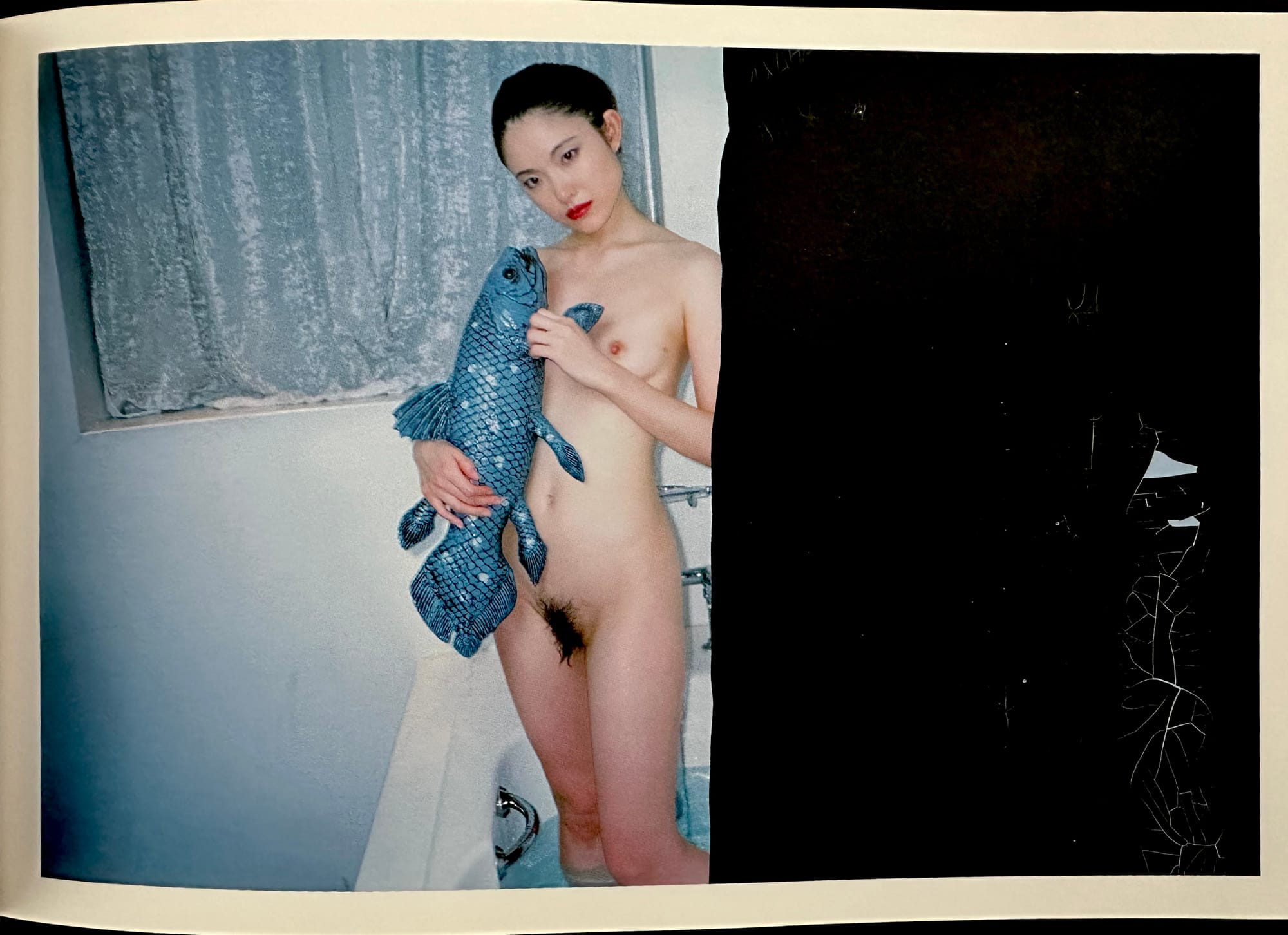
When looking at Elsken and Araki’s works together, what is more striking than the search for similarities is the emotional dissonance between the two: one is frenetic and full of life, there are always multiple others crowding the room and the frame. The viewer never feels totally alone with themselves or even with an intimate other in Elsken's world. It is performative in that it is cinematic: sprawling, filled with character and narrative arcs, a beginning, a middle and an end. Araki's experiment, in contrast, is singular and sometimes antiseptic. There is no warmth, no shared co-mingling, no risk of love or loss here because none is offered and none taken. There is performance, but it is a transactional performance. I do not feel relationship coursing between the photographer and the subject, not in the same way that I do with Elsken. There are no close ups. There is not competition for attention or hearts. The story, if there is one, is of something being played out past its expiration date. Over-determined.
But that is not to say that it isn't affecting.
Elsken's loss of love is literal. Araki's loss of love is the gradual death of something being taken from you, slowly but inevitably and irretrievably. In Elsken's story a body and a heart is being taken from a protagonist by an antagonist. In Araki's, his is an elegy to himself, who occupies both roles and always has.
Araki's ritualistic repetition borders on visual superstition. As if re-photographing the same subjects, scenes, models, props and city were a way to ward off something unpleasant or evil, like skipping over all of the cracks in the sidewalk. The constancy of vision is like the repetition of a mantra, a mantra that some part of him believes keeps him alive, keeps him standing, keeps him shooting his camera.
If Fukase's was a literal loss of a love (muse) in Yoko, and Seiichi Furyua's loss was a casualty to madness, is Araki's loss the loss of the love of self?
And is losing oneself to one's own self-conception the most universally understood form of the three?
Who is Araki without Araki's all-consuming-eye?
Who is Araki when he cannot undress, gobble up, extract, exploit, tie up and capture women and the world with each impetuous want his eyes make of him? What happens when you stop wanting?
The end of a marriage is also the end of a wanting and a choosing. Or, more precisely, it is a choosing of something other than what you’ve wanted to choose for most of your married life. Who are we when not in relation to our spouse? How do we see ourselves when it is not half of a perceived whole? What happens when change is forced upon you, and you must excise half of your life from what it was connected to? How do we take control of the narrative? How do we begin to author a new one?
Elsken tells us that we can weave the story into one that makes our lives feel more emotionally true than the reality that the facts suggest. Araki offers us another possibility: you don’t need the part of life that you cannot see in order to keep on living it. So it's okay to forget that it's there.